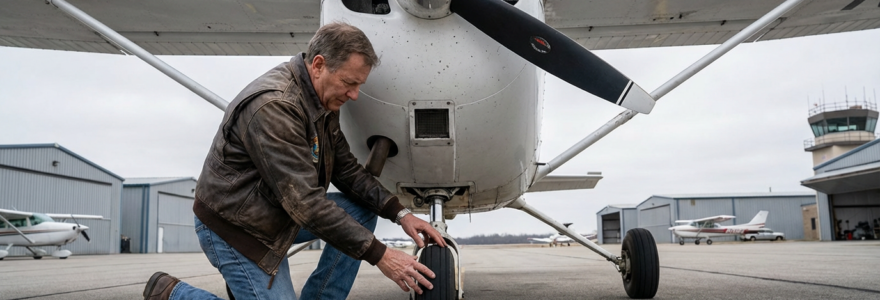
Last spring, a pilot I advise called me in a panic. He had just ground-looped a rented Cessna 172. The FBO was demanding $47,000 for repairs. He assumed the flight school’s policy covered him. It did not. That phone call cost him his savings and nearly ended his flying career before it really started.
Important Information
This content is provided for informational purposes and does not constitute insurance advice. Coverage requirements vary by state, aircraft type, and intended use. Consult a licensed aviation insurance broker for personalized guidance.
- FAA does not mandate insurance for private pilots—but most FBOs require $1 million liability coverage
- Flight school policies typically protect the school, not you as the student or renter
- Non-owned aircraft insurance costs $100-$500 annually and fills the coverage gap for renters
- Always verify your personal coverage before solo flights or renting from any FBO
The Real Risks of Flying Without Proper Coverage
Here is what catches most pilots off guard: the FAA does not require you to carry insurance for private flying. According to 14 CFR Part 205, only commercial air carriers must maintain mandatory liability coverage. Private operations under Part 91? No federal requirement whatsoever.
That regulatory silence creates a dangerous assumption. Pilots think “no requirement” means “no need.” The reality on the ground tells a different story.
The Financial Exposure You Face: A single general aviation incident can generate liability claims exceeding $100,000. Property damage, passenger injuries, third-party claims—the costs stack up faster than most pilots realize. Without coverage, your personal assets are on the line.
Most airports and FBOs fill the regulatory gap with their own requirements. The standard I see across the industry: $1 million liability coverage per occurrence with at least $100,000 per passenger, based on 2025 FBO insurance requirements. Try renting an aircraft without meeting those minimums. You will not get the keys.
63%
of aviation claim value comes from collision and crash incidents
The cases I have seen follow a pattern. A pilot rents an aircraft, something goes wrong during taxi or landing, and suddenly they are staring at a five-figure repair bill. They call the FBO expecting help. The FBO points to the rental agreement—the one that clearly states the renter assumes financial responsibility for damage.
My strong opinion on this: if you cannot afford insurance, you cannot afford to fly. The $200-500 annual cost of a non-owned policy is pocket change compared to one bad landing.
What Aviation Insurance Actually Covers
Aviation insurance is not one product—it is a collection of coverage types that work together. Understanding the difference saves you money and protects what matters. Think of it like building a safety net: some layers catch big problems, others handle smaller but common issues.
The comparison below breaks down the four main coverage types based on what they protect and who actually needs them:
| Coverage Type | What It Protects | Who Needs It | Typical Cost Range |
|---|---|---|---|
| Liability Coverage | Bodily injury and property damage to third parties | Every pilot—owners, renters, students | $300-800/year (liability only) |
| Hull Coverage | Physical damage to the aircraft itself | Aircraft owners | $1,500-2,000/year for small aircraft |
| Non-Owned Aircraft | Liability when flying aircraft you do not own | Renters and students | $100-500/year |
| Medical Payments | Passenger medical expenses regardless of fault | Pilots who carry passengers | Added to liability policy |
The cost data comes from 2025 aviation insurance cost analysis. Small aircraft insurance runs $1,500 to $2,000 annually for full coverage. Non-owned policies for renters and students fall between $100 and $500 depending on your experience level and coverage amount.
A key distinction most pilots miss: hull coverage splits into “in-motion” and “not-in-motion.” In-motion covers taxiing, takeoff, flight, and landing—the risky parts. Not-in-motion handles damage while parked or hangared. The premium difference matters when you are building your policy.
If you are planning a long-term career in aviation, understanding these fundamentals early pays off. The protection you build now supports your growth, whether that means aviation insurance for your career as a CFI or transitioning to aircraft ownership.
My recommendation: start with liability. Always. Hull coverage matters for owners, but liability is what protects you from financial ruin. A dented wingtip hurts. A six-figure lawsuit destroys.
Coverage Gaps That Catch Pilots Off Guard
One pattern I see repeatedly: pilots assume the flight school or FBO insurance protects them. In most cases I have reviewed, that coverage only protects the aircraft owner—not you as the pilot in command. This misunderstanding has left pilots facing personal liability claims exceeding $100,000.
When Coverage Assumptions Fail: Marcus’s Story
Marcus, 28, a software engineer and newly licensed private pilot, was renting Cessnas from his local FBO for weekend flying. He assumed the rental agreement included liability coverage—it seemed logical. After a minor ground incident (wingtip clipped a hangar door during taxi), he discovered the gap. The FBO’s policy protected the FBO. His rental agreement explicitly assigned financial responsibility to him. He faced a $12,000 repair bill with no coverage to absorb it.
Resolution: Marcus obtained a personal non-owned aircraft policy for around $350 annually. That policy now protects him whenever he rents, regardless of the FBO.
AOPA guidance on renter pilot coverage confirms this pattern: flight schools typically carry insurance policies that only cover the flight school itself. The student or renter? Exposed.
The Student Pilot Blind Spot: Many flight schools require students to carry $250,000 to $1,000,000 in non-owned aircraft insurance before solo flights. If your school does not require it, that does not mean you do not need it. It means the school is shifting the risk entirely to you.
Student pilot insurance costs range from $500 to $1,500 annually—more expensive than private pilot rates because underwriters see higher risk in inexperienced pilots. But that cost is nothing compared to the alternative. If you are early in your training, exploring options like student pilot insurance should happen before your first solo, not after your first incident.
The gaps I encounter most often in my work with pilots:
- Assuming FBO or club policies cover renter liability (they usually do not)
- Flying borrowed aircraft without verifying the owner’s policy includes you as a named pilot
- Carrying passengers without adequate medical payments coverage
- Letting policies lapse and forgetting to reinstate before the next flight
Frankly, most of these gaps exist because pilots do not read the fine print. The rental agreement, the insurance certificate, the policy declarations page—these documents answer the question “am I actually covered?” Reading them takes thirty minutes. Ignoring them can cost you everything.
How to Get the Right Policy for Your Flying
Getting the right policy is not about finding the cheapest quote. It is about matching coverage to your actual flying. A student renting 172s needs different protection than an owner flying a Bonanza cross-country with passengers.
The process typically follows this timeline based on what I see with clients:
-
Submit quote request with pilot certificate and logbook summary -
Underwriter reviews experience, asks follow-up questions -
Quote received with coverage options and premium breakdown -
Policy bound, coverage documents issued
Before you rent from any FBO, run through this verification:
5 Questions Before You Rent Any Aircraft
-
Does the FBO’s insurance cover me as the renter pilot, or only the aircraft owner?
-
What is my financial responsibility if I damage the aircraft during taxi, takeoff, or landing?
-
Does my personal non-owned policy meet the FBO’s minimum liability requirements?
-
Am I listed as a named pilot on the owner’s policy if borrowing an aircraft?
-
Is my coverage current, or has my policy lapsed since my last flight?
Field-Tested Advice: When advising clients, I always stress this: get quotes from at least two brokers. Premiums vary significantly based on how underwriters assess your experience. AOPA’s insurance services and independent aviation brokers often provide different rates for identical coverage.
The underwriters care about your flight hours, recency of experience, type ratings, and claims history. Pilots with 200+ hours and no incidents pay less than fresh private pilots. That is just the math of risk assessment.
Building your aviation credentials strategically helps on multiple fronts—better insurance rates, more opportunities, and career advancement. If you are mapping out your path, reviewing the best diplomas for aviation careers gives you a clearer picture of how education and protection work together.
Soyons clairs: the pilot who invests in proper coverage from day one spends less over a flying career than the pilot who learns the hard way. One ground incident without insurance can cost more than a decade of premiums.
Your Next Step
You now understand why coverage matters, what the main policy types protect, and where the gaps hide. The question is whether you will act on it before your next flight or wait until something goes wrong.
If you are renting or still in training, a non-owned aircraft policy costing $100-500 annually eliminates your biggest exposure. If you own or plan to own, work with a broker who understands general aviation—not someone who mostly sells auto policies.
One question to consider before your next flight: can you prove, right now, that you are covered if something goes wrong on the ramp or in the pattern? If the answer is “I think so” or “probably,” that is not good enough. Verify. Then fly.
Aviation Insurance: Common Questions
Do student pilots need their own insurance?
Yes. Many flight schools require students to carry non-owned aircraft insurance before solo flights. Even when not required, personal coverage protects you from liability if you damage the training aircraft. Student pilot insurance typically costs $500-1,500 annually.
What is non-owned aircraft insurance?
Non-owned aircraft insurance provides liability coverage when you fly aircraft you do not own—rentals, borrowed planes, or club aircraft. It fills the gap when the owner’s policy does not extend to you as the pilot. Annual premiums range from $100 to $500.
How much does aviation insurance cost for private pilots?
Liability-only policies for private pilots typically cost $300-800 annually. Full coverage (liability plus hull) for small aircraft like a Cessna 172 runs $1,500-2,000 per year. Rates depend on your experience, hours flown, and claims history.
Does the flight school’s insurance cover me as a student?
Usually not. Flight school policies typically protect the school and aircraft owner, not you as the student pilot. If you damage the aircraft or cause an incident, you may face personal liability. Always verify coverage details before assuming protection.
What happens if I damage a rental aircraft without insurance?
You are personally liable for repair costs, which can range from thousands to tens of thousands of dollars. The rental agreement typically assigns financial responsibility to the renter. Without coverage, your personal assets are at risk, and the FBO can pursue you for damages.
Limitations and Precautions: Insurance requirements and premiums vary significantly by state, aircraft type, and pilot experience. Policy terms, exclusions, and coverage limits differ between providers. This guide provides general information and cannot replace consultation with a licensed aviation insurance broker or AOPA insurance services.